The Bogans
(Wicks Publishing 2020)

Park Court is a fairly typical Melbourne neighbourhood, hosting a very diverse, multicultural community. Africans, Indians, Chinese, Lebanese, Sri Lankans, Christians, Muslims, straight and gay people, they all live there, and not always peacefully. What is lacking, however, is a White family to complete the diversity. But when one finally moves into the court, it is more than what anyone had bargained for.
“An often funny, always generous, and very timely examination of race, class, sexuality, religion, family and more, reflecting the rich diversity and sometimes fraught complexity of Australia’s multicultural realities that goes beyond labels and and misperceptions to the big heart of ‘Aussieness’ in all its forms, that we are all neighbours, all people, and all Australians, no matter where we have ‘really come’ from.”
– Sunil Badami, Writer, Academic and Broadcaster
Tracks
(Self-published 2015)

A novel about growing up, friendship, and unrequited love.
Shehan has a crush on Robbie, his classmate and friend. Robbie is straight and finds Shehan’s affections unsettling. But then, that is all he has going for him in his turbulent life. When they both realize it, it is already too late.
“A moving story about a boy’s navigation through the confusing world of adolescent sexuality. Shehan’s journey to emotional maturity with its devastating impact on his beloved Robbie is described sensitivity and poignancy.”
– Associate Professor Chandani Lokuge, School of Languages, Cultures and Linguistics, Monash University
“Wickremesekera weaves this bleak tale with a fine ear for the language and mores of young people and leavens the inevitable sadness and tragedy with a sardonic wit and an honest take on adolescent sexuality.”
Michael Cooke, Green Left Weekly
“This story is confronting, because it shows how darkness encroaches into the everyday lives of people and how it enters our lives through our longings and desires….The first person narrative powerfully immerses the reader into Shehan’s point of view. This engages us to inhabit his perspective, taking us past the point of judgement or personal distaste, latent homophobia or prejudice against violent ‘yobbo’ delinquent youth.”
Devika Brendan, Ceylon Today
Asylum
(Self-published 2014, Palaver Books 2015)

What happens when an Aussie seeks asylum in a Muslim home – in Australia?
Set in contemporary Australia the novella describes a day in the life of an Afghan family in suburban Melbourne forced to confront an unwelcome visitor. What follows is a poignant – and hilarious – intercultural encounter in multicultural Australia.
“A fun novel written in a jaunty teen voice – a novel that tries to tip our assumptions on their heads and succeeds”
– Anna Funder, author of Stasiland and All that I am
“This is a timely novel, written with daring and imagination. It deals with themes that we urgently need to engage with and reflect upon, challenges that cry out for a long-overdue national conversation.”
– Arnold Zable, author of Cafe Sherazade, The Fig Tree and Violin Lessons
“Generally, the author’s agenda is unobtrusively didactic in the search for a cosmopolitanism that could bridge and unite Australia’s white/ethnic cultural divisions. This didacticism is indiscriminately and wittily sprinkled in the novella: the white teenager and Khalid’s father share the shortened name “Rusty”, suggesting that they are both, irrespective of race, essentially one and the same person; all religions finally lead to one basic truth: Allah is also God. Most telling is how the author paves the way to a fleeting dialogue suggestive of positive future relationships between the racially differentiated teenagers, Khalid, his younger sister Aisha and Rusty, across the common ground for all Australians – “footy” – the most popular and iconic Australian outdoor team sport. It is also realistic, perhaps, that the conversation, at least at this incipient stage of interaction, belongs only to the younger Australians; the parents are excluded. It follows that the older generation would have misunderstood and stifled the exchange before it had a chance to breathe. The clinching point of the novel is its play on the meaning of “asylum” as it is applied in Australia. With the Afghani family offering its protection to Rusty, Australia’s centre–periphery power relations are ironically reversed: the white Australian becomes the asylum seeker reliant on the patronage of the migrant family. Khalid’s appreciation of his father’s interpretation of his religious and cultural mores, one that accommodates the principle of protecting the fugitive, is indeed a hopeful gesture. It communicates the open transcultural space that can evolve between coexisting cultures.
Asylum thus offers a new route of hope into cosmopolitanism that is perhaps more effective than multicultural food fairs or festivals, because it offers a more intimate affective experience. It challenges Australia to recognize the development of vitally important relationships that bridge the cultural divide. As Yasmine Gooneratne rightly concludes in her review of this novel entitled “A Message for Everyone on Multiculturalism”, in The Sunday Times, June 29, 2014 Gooneratne, Yasmine. 2014. “A Message for Everyone on Multi-culturalism.” The Sunday Times Sri Lanka, June 29. http://www.sundaytimes.lk/140629/plus/booksarts-104929.html, “Asylum [ … ] has a message for everyone who can read and think beyond the confines of their own limited conditioning, and understand [as the characters in the novel eventually do] the value of a multicultural experience”
– Associate Professor Chandani Lokuge, ‘Mediating Literary Borders: Sri Lankan Writing in Australia,’ in the Journal of Post-Colonial Writing, December 2016.
In the Same Boat
(Self-published 2010)
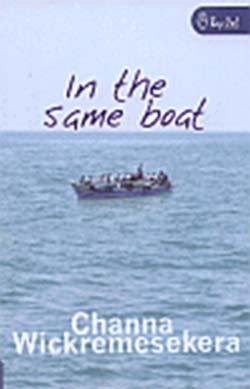
The story of a boatload of nameless people, fleeing their devastated homeland into a gathering storm. The travails of the journey reveal the fugitives to be victims as well as perpetrators making it a gripping drama of the human condition.
A powerful and disturbing tale for our times in which the historical and the allegorical are combined with consummate skill. Channa Wickremesekera is among the most astute, inventive and courageous of Sri Lanka diasporic writers today.”
– Associate Professor Suvendrini Perea, Curtin University of Technology
Distant Warriors
(Perera-Hussein Publishing House, Colombo 2005)
The novel explores the prejudices and hypocrisies that follow Sri Lankans migrants into their new homes in the West. It’s the height of the ethnic conflict in Sri Lanka and the ethnic tensions are spilling over to Melbourne too. The Tamil community in Melbourne that supports the rebels’ cause in Sri Lanka are organising a fundraiser and inviting a well-known activist from northern Sri Lanka to grace the occasion. The Sinhala hardliners get wind of the preparations and are determined to gatecrash the event leading to tragic consequences.
Walls
(Self-published, 2002)
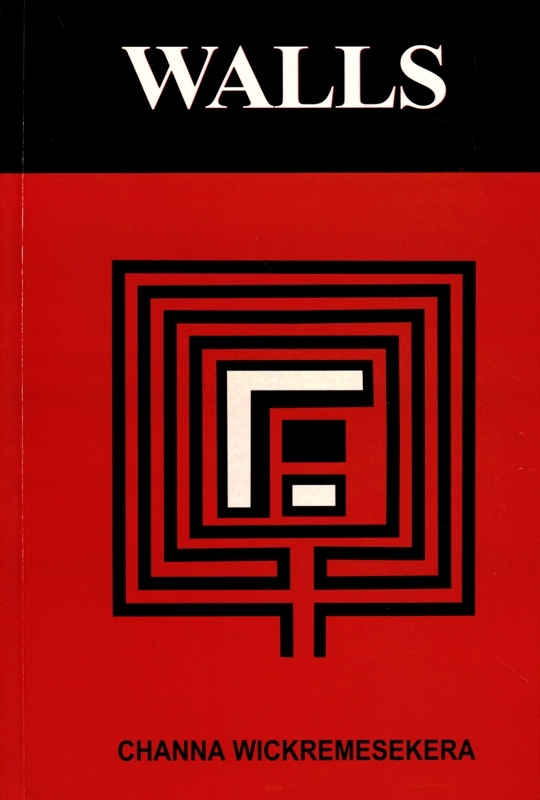
Walls is the story of a crisis in a Sri Lankan family, the Abeywickremes. Having emigrated to Melbourne to escape the uncertainties of life in Sri Lanka and to ensure a bright future for their daughter Ishara, they find their lives thrown into fresh turmoil by Ishara’s sexuality. Their attempts to deal with it are as hilarious as they are moving.
“This short novel, frequently funny, with a sharp satirical edge to its humour, but also sometimes emotionally poignant – marks the striking debut of a writer of original talent.”
– Regi Siriwardena, Author and literary critic
 CHANNA WICKREMESEKERA