A Modest Arsenal: Gunpowder Weapons in Sri Lanka 1500 – 1820.

The adoption of gunpowder weapons was a watershed in military history, changing the way armies fought and the way they were organized. This book explores the adoption and use of firearms and artillery by Sri Lankans, the impact of these weapons on warfare and their incorporation into the military organization in the island. Using a wide range of sources, it delves into the technological, economic and political conditions and considerations that influenced these processes. The period covered is roughly 1500 to 1820. This corresponds approximately to the period spanning the first contact between Europeans and Sri Lanka in 1505, and the last major armed resistance to European power in the island in 1817-18. This is the first in-depth treatment of the subject by a military historian.
Published by Tambapanni Academic Publishers, Colombo, Sri Lanka, 2024.
The Tough Apprenticeship: Sri Lanka’s Armed Forces Against the Tamil Militants 1979 – 1987

The Sri Lankan security forces that defeated the Liberation Tigers of Tamil Ealam (LTTE) in 2009 evolved with that military conflict . Beginning as little more than ceremonial establishments of a few thousand men, they matured during the course of the conflict into large, effective fighting forces that were eventually capable of completely defeating one of the most dangerous guerrilla organisations in the world.
Using a wide range of sources Wickremesekera examines the challenges faced by Sri Lanka’s military forces during the first phase of this conflict, starting with the first deployment of the army in the Jaffna peninsula to combat terrorism in 1979 to the first major military operation conducted by the Sri Lankan armed forces in May 1987. It was a time of unprecedented stress and strain for a small Third World military with little or no experience in handling the threat from a ruthless and highly motivated enemy. The military’s response demonstrated their inadequate training as well as their political masters’ skewed perception of the conflict., frequently leading to disastrous outcomes. But it was also a period of learning. Despite many bloody setbacks and failures the armed forces gradually learned the rudiments of fighting a guerrilla enemy, the culmination of this apprenticeship being the launching of ‘Operation Liberation’, the first brigade-strength operation conducted by the Sri Lankan army. Its conduct and the end result showed that while the armed forces still had a lot to learn, now they were by no means the bumbling amateurs they were at the beginning of the conflict.
The Tamil Separatist War in Sri Lanka (New York: Routledge, 2016)

The complex and long-drawn war between the Sri Lankan government and the Liberation Tigers of Tamil Eelam (LTTE) ended with the defeat of the Tigers in 2009. This book provides a military history of the conflict in tracing its evolution from a battle between a ragtag guerrilla force and a mainly ceremonial army to one between an organized guerrilla force with semi-conventional capability and a state military apparatus that had morphed into a large and potent force with modern armour, aircraft and naval vessels. Using a wide range of sources this book offers an incisive analysis of the progress and conclusion of one of the longest and most destructive wars in modern South Asia.
Kandy at War: Indigenous Military Resistance to European Expansion in Sri Lanka 1594 – 1818 (New Delhi: Manohar, 2004)
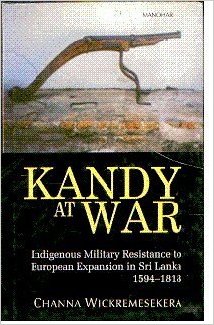
The Kingdom Of Kandy in the Central Highlands of Sri Lanka Presents one of ihe finest bexamples of effective military resistance to european expansion by a small, economically backward state in the South Asian region, and perhaps, in the world. Kandy, a landlocked state with a subsistence economy, few material resources and a small population by regional standards, has the unique distinction of resisting European expansion for over two centuries. Between 1594 and 1818 Kandy battled against the armies of three European powers established in the Coast: the Portuguese, the Dutch And the British and preserved its independence until the kingdom was betrayed by disgruntled nobles in 1815. From the perspective of small state resistance to European Arms this was serious and significant resistance, perhaps the most significant of its kind in the region. Yet it has so far received little attention from scholars working on Asian military history or on Sri Lankan history. This study is the first serious attempt to fill this void.
‘Best Black Troops in the World’: British Perceptions and the Making of the Sepoy 1746 – 1805 (New Delhi:Manohar 2002)
The eighteenth century was a time when the British were just beginning to find their way in the cultural landscape of India. The early Orientalists were the pioneers who mapped out this landscape, the knowledge generated by them representing India as not only different but also inferior to the West. This perception of Indian inferiority extended tot hide military sphere as well. The inability of vast, yet undisciplined Indian armies to stand up to miniscule forces of drilled European infantry and field artillery convinced many in the British camp of an ‘invincible timidity’ in the Indian soldier.
This book explores the role played by British perceptions of the Indian soldier and Indian culture in the formation of the English East India Company’s sepoy army in the eighteenth centuy. It explores the influence of British perceptions on the sepoy’s place from the barrack room to the battlefield, demonstrating that prejudice was a cornerstone in the making of the Company’s ‘native’ army.
attempt to fill this void.
 CHANNA WICKREMESEKERA